Russian Manicure: What It Is, How It Works, Benefits, Risks, and What to Expect
Russian manicure is a precise dry manicure technique that uses an electric nail file and specialized bits to clean and refine the area around the nails. It creates a very neat cuticle line and allows polish or gel to be applied close to the nail base.
What Is a Russian Manicure?
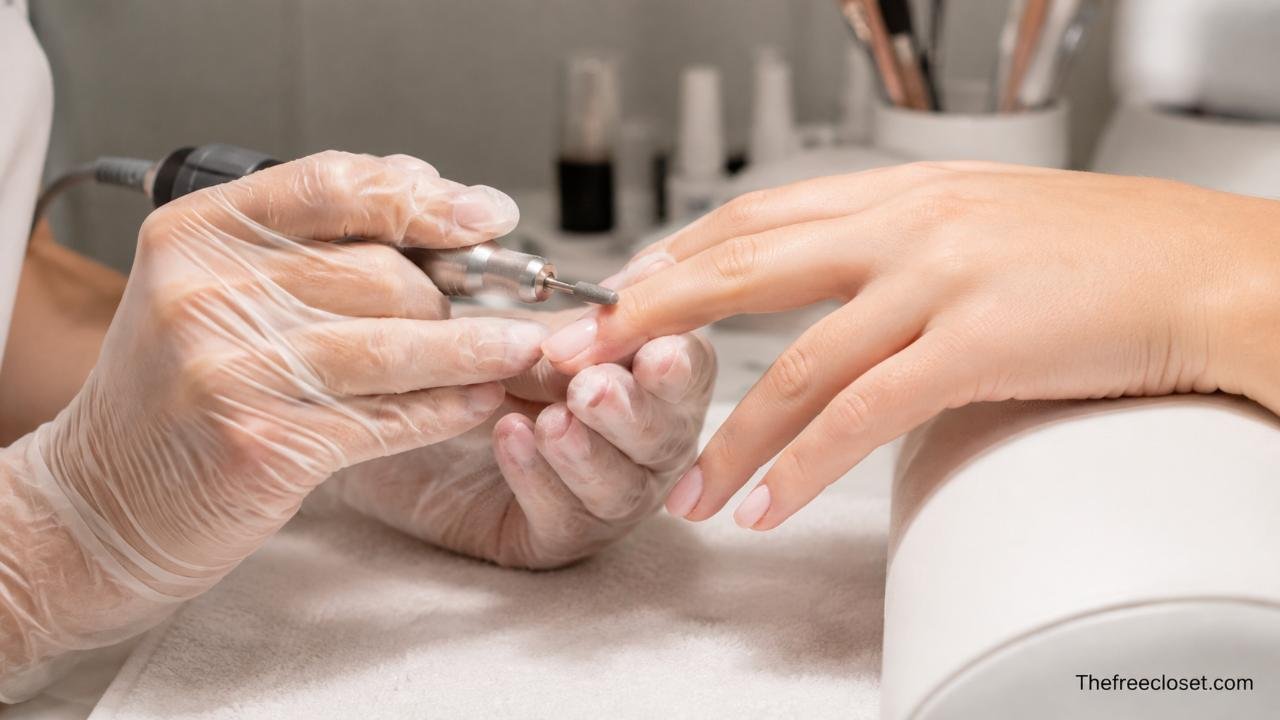
A Russian manicure, sometimes called a dry manicure or e-file manicure, is a nail-preparation technique performed without soaking the fingers in water first. Instead, a nail technician typically uses an electric file with small rotating bits to work around the nail plate and surrounding skin.
The goal is usually greater precision than a conventional manicure provides. By carefully cleaning the area around the proximal nail fold and preparing the nail surface, the technician can create a very crisp transition between the nail color and surrounding skin.
A Russian manicure is not simply a particular nail shape or polish style. You can have short nude nails, almond-shaped gel nails, French tips, or another design while using Russian-style preparation. The term primarily describes how the nail and surrounding skin are prepared.
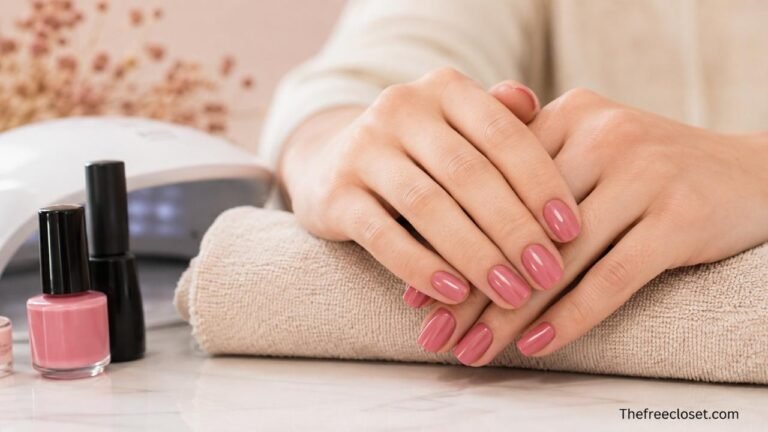
The technique has become especially recognizable because photographs often show polish appearing almost seamlessly connected to the skin with little visible gap at the base.
How a Russian Manicure Is Done
The exact process varies by technician, nail condition, and product system. However, the defining feature is detailed dry preparation around the nail using an e-file rather than relying primarily on soaking and manual cuticle pushing.
A typical appointment may involve:
- Assessing the natural nails and surrounding skin. The technician checks the nail plate, existing product, shape, and condition of the surrounding tissue.
- Removing existing polish or gel. Old material may be soaked off or carefully reduced with an electric file, depending on the product.
- Shaping the free edge. The natural nail is filed into the chosen square, oval, almond, squoval, or other shape.
- Performing dry nail-fold preparation. Fine e-file bits may be used around the base and sides of the nail to lift and remove dry or excess tissue.
- Refining the surrounding area. Some versions of the technique include trimming loose skin with scissors or nippers.
- Preparing the nail plate. Oil, dust, and surface irregularities are removed before the coating system is applied.
- Applying base or structured gel. Depending on the service, a strengthening or leveling layer may be added to create a smoother nail architecture.
- Applying color close to the base of the nail. Precision application produces the characteristic clean, almost gap-free appearance.
- Curing and finishing. Gel products are cured under the appropriate lamp, followed by top coat and finishing care.
The manicure may take longer than a basic salon manicure because a significant portion of the appointment is devoted to preparation rather than simply shaping and painting the nails.
Russian Manicure vs. Regular Manicure
The largest difference is not the final nail color. It is the preparation technique.
| Feature | Russian manicure | Traditional manicure |
| Nail soaking | Usually performed dry | May include soaking |
| Primary preparation tools | Electric file and specialized bits | Manual file, pusher and often nippers |
| Work around nail folds | Highly detailed | Usually less extensive |
| Polish placement | Often extremely close to the base | Usually leaves a more visible margin |
| Typical appearance | Precise, highly defined cuticle line | Clean but generally less exact |
| Skill requirement | Requires strong e-file control | Technique varies widely |
| Main concern | Excessive removal can damage protective tissue | Cutting or aggressive pushing can also damage cuticles |
Neither category automatically determines whether a manicure is safe or unsafe. Technique, tool sanitation, product handling, and how aggressively the tissue is treated matter more than the name of the service.
A poorly performed conventional manicure can damage skin just as an overly aggressive Russian manicure can. The difference is that Russian manicures intentionally involve much more detailed work in an anatomically sensitive area.
Why Russian Manicures Look So Clean
The characteristic appearance comes largely from preparation around the base and sides of each nail.
When dry skin and excess tissue are carefully cleared away, the technician has a sharply defined area in which to apply polish. Color can therefore be placed much closer to the proximal nail fold than during many standard manicures.
The result can make the nail plate appear longer and produce a smooth transition between polish and skin.
This precision can also make early nail growth less visually obvious. It does not slow the biological growth of the nail, however. Your natural nail continues growing normally regardless of how close the original polish application was.
That distinction matters because claims that the technique itself makes nails “grow more slowly” or fundamentally changes the growth cycle are misleading.
Does a Russian Manicure Last Longer?
A Russian manicure can look freshly applied for longer than some conventional manicures, particularly when gel is placed very close to the base of the nail.
That does not mean the manicure stops nail growth or guarantees longer product adhesion. Longevity also depends on the coating system, nail preparation, natural nail flexibility, daily activities, chemical exposure, product thickness, curing, and application technique.
For example, someone whose nails grow quickly will develop a visible gap sooner than someone with slower nail growth, even if both receive technically identical manicures.
Another important distinction is between appearance and adhesion. Precise polish placement may hide early growth, while good product preparation determines whether the coating resists lifting and chipping.
Are Russian Manicures Safe?
Russian manicures involve a genuine trade-off: extremely precise cosmetic results can require working close to tissue that protects the nail.
The AAD specifically cautions against Russian manicures that remove the cuticle. Dermatologists explain that the cuticle serves as a barrier between the nail and surrounding environment. Breaching it can provide bacteria or fungi with an opportunity to enter the area around the nail. The AAD notes that paronychia, which causes inflammation around the nail, is one possible complication.
More generally, AAD manicure-safety guidance recommends that cuticles should not be cut or forcefully pushed back. The organization also advises salon customers to pay attention to technician experience, workstation cleanliness, hand hygiene, and how instruments are cleaned between clients.
That does not mean every person who receives this style of manicure will develop a problem. It means that removing or injuring protective tissue introduces a risk that should not be dismissed simply because the finished manicure looks precise.
Cuticle vs. Proximal Nail Fold: An Important Distinction
One of the most useful distinctions when discussing Russian manicures is the difference between the cuticle and the living skin surrounding the nail.
In everyday salon language, almost everything around the base of the nail is frequently called the cuticle. Anatomically, the situation is more complicated. Some material attached to the nail plate consists of dead keratinized tissue, while the proximal nail fold contains living skin and forms part of the protective structure surrounding the developing nail.
This distinction helps explain why technique matters so much. Removing loose dead tissue from the nail plate is not necessarily equivalent to aggressively cutting living tissue.
For a customer, however, it can be difficult to determine exactly what is being removed during a fast-moving e-file service. That is one reason technician training and conservative technique matter.
What Can Go Wrong With an Aggressive Russian Manicure?
The most obvious warning signs are pain, bleeding, burning, or visible injury during the appointment. Precision should not require cutting into healthy living tissue.
Overworking the area can result in tenderness, redness, inflammation, or breaks in the skin. Damage to the protective barrier may also make bacterial or fungal infection more likely. Dermatologists advise leaving cuticles intact precisely because they help block microorganisms from entering around the nail.
Repeated trauma can create another problem: a customer may begin expecting increasingly aggressive trimming simply because the regrowing skin feels rougher than it originally did.
If the skin around a nail becomes increasingly painful, swollen, warm, discolored, or produces drainage after a manicure, those symptoms should not be treated as a normal part of the service. Medical evaluation may be appropriate, particularly when signs of infection are present.
How to Choose a Russian Manicure Nail Technician
The finished Instagram photo tells you very little about sanitation or how gently the manicure was performed. A technically responsible service should protect the nail and surrounding tissue rather than prioritize an ultra-clean photograph at any cost.
Before booking, evaluate the technician’s approach as carefully as their portfolio. Useful questions include how reusable e-file bits are cleaned between customers, which tools are single-use, whether the technician is appropriately licensed where local rules require licensing, and whether they modify the service when the skin is irritated or damaged.
The AAD recommends looking at salon cleanliness, technician experience or licensing where applicable, hand hygiene, dirty tools, and the salon’s instrument-cleaning practices.
A technician who is willing to explain sanitation and stop when tissue becomes sensitive is generally more reassuring than one who presents bleeding as evidence of “deep cleaning.”
Who Should Be More Cautious?
Anyone with damaged skin around the nails should avoid having that area aggressively filed or cut until it has healed.
Extra caution also makes sense when a nail is already painful, swollen, discolored, lifting, or showing another unexplained change. Covering a problem with gel can make it harder to observe and may delay appropriate treatment.
The AAD advises against using artificial nails simply to conceal nail problems because artificial products can worsen some existing conditions. Changes in nail color, texture, or shape sometimes warrant evaluation by a dermatologist.
People with individual medical conditions that affect wound healing or infection risk should seek personalized medical guidance rather than relying on general salon advice.
Russian Manicure With Gel vs. Russian Manicure Alone
A common misconception is that Russian manicure automatically means structured gel nails.
It does not.
The Russian manicure describes the preparation technique. Structured gel describes the product and nail-building technique that may be applied afterward.
They are frequently combined because structured gel can smooth unevenness, reinforce the nail, and create a highly controlled shape that complements precise cuticle preparation. However, a salon could theoretically perform Russian-style preparation followed by another compatible nail coating.
This distinction is helpful when comparing prices. One salon may advertise a Russian manicure that includes extensive preparation, structured gel, color, and shaping, while another may quote preparation separately.
Always compare what the service actually includes rather than comparing the service name alone.
How Much Does a Russian Manicure Cost?
There is no meaningful universal price for a Russian manicure.
Pricing varies considerably according to country, city, technician training, appointment length, gel system, nail length, removal requirements, extensions, repairs, and nail art.
Because the technique generally requires detailed manual work and specialized e-file skills, it may cost more than a basic manicure in the same market.
When comparing salons, the cheapest appointment is not automatically the best value. Sanitation procedures, conservative technique, product quality, and technician skill matter because the service involves both the nail plate and surrounding skin.
How Long Does a Russian Manicure Take?
Expect a Russian manicure to take longer than a quick polish change or basic manicure.
The technician may need to remove old material, prepare ten separate nail folds, shape every nail, level the nail surface or gel structure, apply color precisely, cure each layer, and complete finishing work.
More complicated nail corrections, long nails, extensions, repairs, French designs, and detailed nail art add additional time.
A faster appointment is therefore not necessarily an advantage. Excessive speed with rotating tools near the skin can be less desirable than careful, controlled preparation.
Russian Manicure vs. Gel Manicure
These terms describe different things and should not be treated as competing categories.
A gel manicure tells you mainly what type of coating is being applied and cured. A Russian manicure tells you mainly how the nails and surrounding area are prepared.
You can therefore have a Russian manicure followed by gel polish. You can also have a traditional manicure followed by the same gel polish.
When deciding between salons, ask two separate questions: how will my nail area be prepared, and what coating will be applied afterward?
That gives you more useful information than simply asking whether the service is “gel” or “Russian.”
Is a Russian Manicure Worth It?
A Russian manicure may appeal to someone whose main priority is an exceptionally clean, precise nail appearance. The detailed preparation and close color application can create a finish that is difficult to reproduce with a quick conventional manicure.
The trade-off is that greater intervention around the nail folds is not automatically healthier nail care. Dermatology guidance favors protecting the cuticle rather than removing it because it functions as a barrier against infection.
A sensible decision therefore depends less on whether Russian manicures are fashionable and more on how the individual technician performs the service.
The best cosmetic result should still respect intact, healthy tissue.
Conclusion
A Russian manicure stands out for its detailed dry preparation, precise polish application, and exceptionally clean finish. However, the quality of the result depends heavily on the technician’s skill, hygiene practices, and ability to work carefully around the nail and surrounding skin.
If you like a polished, highly refined look, the technique may be appealing, but healthy nails should remain the priority. Choose a trained technician who uses properly sanitized tools, avoids unnecessary damage to living tissue, and does not consider pain or bleeding a normal part of the service. A beautiful Russian manicure should deliver precision without compromising nail or skin health.
Discover the latest fashion trends, home ideas, travel tips, and lifestyle inspiration at thefreecloset.com.
FAQ’s
It should not require significant pain. Mild sensations from filing may occur, but sharp pain, burning, repeated discomfort, or bleeding can indicate that living tissue is being irritated or damaged. Tell the technician immediately rather than assuming pain is part of achieving a cleaner result.
It can if the e-file is used too aggressively on the nail plate or surrounding tissue. Excessive filing can thin or weaken the natural nail, while aggressive work around the cuticle can compromise the skin’s protective barrier. Proper tool control and conservative preparation are therefore important.
The technique is generally performed dry because e-file work and precise preparation are easier when the nail and surrounding tissue have not been softened or expanded by soaking. The dry approach also gives the technician a clear view of the area being worked on.
Yes. The technique concerns nail preparation rather than length. Short natural nails can receive Russian-style preparation, although the final design and product system should be selected according to the condition and structure of the natural nail.
There is no single medically established interval that applies to everyone. Nail growth rate, coating condition, skin health, and the amount of intervention performed all matter. Repeatedly removing healthy tissue simply because a scheduled appointment has arrived is not a good reason to overwork the nail area.
The technique is poorly suited to casual experimentation with an e-file. Rotating bits can damage the nail plate or living tissue quickly when pressure, speed, angle, or bit selection is wrong. Home nail care that leaves the cuticle intact is more consistent with dermatologists’ recommendations for reducing infection risk.