

Best Time to Spray Weed Killer: Weather, Season, and Timing Guide
The best time to spray weed killer is when weeds are actively growing, their leaves are dry, temperatures are moderate, and there is enough rain-free time for the herbicide to work. Morning after the dew dries is often suitable, but weather conditions and the specific product label matter more than the exact time of day.
What Is the Best Time of Day to Spray Weed Killer?
For most home lawn and garden applications, morning after the dew has dried is often a practical time to spray. Temperatures are usually moderate, weeds are actively growing, and winds may be lighter than during the hotter part of the day. Early evening can sometimes offer similar conditions.
However, do not assume that sunrise or sunset is automatically safest. Very calm conditions around sunrise and sunset can sometimes coincide with temperature inversions, which can keep small spray droplets suspended and increase the risk of off-target movement. Recent University of Minnesota Extension guidance recommends paying attention to wind conditions and avoiding applications during inversions.
For a homeowner, a better rule is to choose the best weather window, rather than a fixed hour:
| Condition | Generally favorable for foliar weed killer | When to reconsider spraying |
| Leaf condition | Clean and dry | Wet from rain, irrigation, or heavy dew |
| Weed condition | Young and actively growing | Wilted, drought-stressed, damaged, or dormant |
| Temperature | Often about 65°F to 85°F | Very cold or excessively hot |
| Wind | Light and within label limits | Strong, gusty, or blowing toward desirable plants |
| Rain | Enough dry time to satisfy the label | Rain expected before the rainfast period |
| Time of day | After dew dries during a suitable weather window | During extreme afternoon heat or an inversion |
These are general guidelines. The product label takes priority because different active ingredients and formulations have different restrictions.
Why Dry Leaves Matter When Spraying Weeds
Foliar weed killers need to remain on the leaves long enough to be absorbed. Spraying wet foliage can dilute the treatment or cause droplets to run off before sufficient herbicide enters the plant.
University of Florida guidance notes that dew can reduce effectiveness when it dilutes the spray or causes runoff. Washington State University Extension similarly recommends applying foliar liquid products to clean, dry, actively growing weeds.
This is one reason spraying immediately at sunrise is not always ideal. If the lawn is covered with heavy dew, wait until the foliage has dried unless your particular product directs otherwise.
There are exceptions. Some granular broadleaf herbicides are specifically intended to stick to moist foliage and may work better when leaves are dew-covered. Always distinguish between a liquid foliar spray and a granular weed-control product.
How Long Should Weed Killer Stay Dry Before Rain?
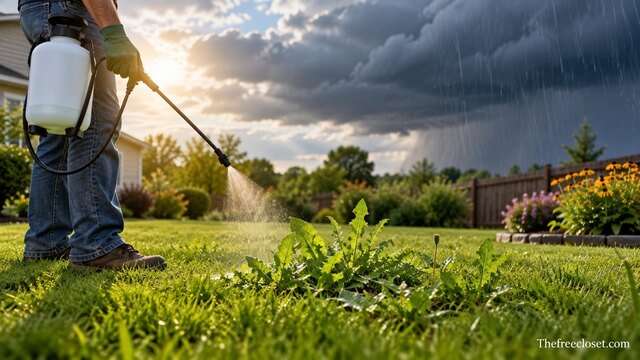
The required dry period depends on the herbicide. This period is commonly called the rainfast period, meaning the amount of time needed between application and rainfall for adequate absorption.
Rain too soon after spraying can wash a post-emergent herbicide from foliage and reduce weed control. Rutgers University notes that the necessary rainfast interval varies among herbicides and can become longer when growing conditions are poor.
As a general planning rule, choosing a window with several hours of dry weather is sensible. Some extension recommendations use roughly four to eight hours as a practical general window, but other products can require shorter or longer periods.
For example, suppose the label requires six rain-free hours. If you spray at 9 a.m. and thunderstorms are expected at noon, waiting for another day is likely the better choice.
Do not rely on a universal number. Check the product’s label for its specific rainfast requirement.
What Temperature Is Best for Spraying Weed Killer?
Many post-emergent herbicides perform well during moderately warm weather, when weeds are actively growing. Rutgers University identifies approximately 65°F to 85°F as an ideal range for many post-emergence herbicides. University of Delaware guidance gives a similar 70°F to 85°F range for post-emergence broadleaf lawn herbicides.
Cold conditions can slow plant growth and herbicide movement through the weed. Extremely hot weather presents a different problem. Heat can increase evaporation and volatility for some herbicides, potentially reducing application quality and increasing the chance of damage to nearby desirable plants.
This is particularly relevant to certain formulations containing active ingredients such as 2,4-D or dicamba. Kansas State University notes that volatility concerns increase at high temperatures and advises following herbicide-specific temperature restrictions.
The practical lesson is simple: don’t choose a spraying day based only on whether it is sunny. Check the temperature range printed on the label.
Should You Spray Weed Killer in the Morning or Evening?
Neither morning nor evening is universally better. Choose whichever period provides dry foliage, acceptable temperature, appropriate wind, actively growing weeds, and sufficient time before rain or irrigation.
Morning can be convenient because temperatures are often cooler. Wait for heavy dew to disappear before applying a foliar spray.
Later in the day may also provide suitable temperatures, especially during warm weather. However, spraying close to sunset is not automatically ideal because atmospheric conditions can sometimes favor temperature inversions. Likewise, spraying in the middle of a hot afternoon can increase evaporation and volatility concerns.
Think of the decision in this order:
- Check the herbicide label.
- Check whether the weeds are actively growing.
- Check the rain forecast and required rainfast period.
- Check temperature, wind speed, and wind direction.
- Make sure the leaves are in the condition required by the product.
- Only then choose the most convenient time of day.
That approach is more reliable than following a blanket rule such as “always spray at 8 a.m.”
What Is the Best Season to Spray Weed Killer?
The best season depends on the weed species and whether you are using a post-emergent or pre-emergent herbicide.
For many broadleaf lawn weeds, spring and fall provide favorable conditions because weeds are actively growing and temperatures are moderate. Penn State and University of Delaware Extension both identify active growth as an important factor in successful post-emergence broadleaf control.
Fall can be particularly useful for controlling certain perennial broadleaf lawn weeds. During active fall growth, systemic herbicides can move through susceptible plants rather than simply damaging exposed foliage.
Spring is also a common treatment period because many weeds are young and actively growing. Young weeds are generally easier to control than large, mature plants.
Summer spraying requires more caution. Hot, dry weather can stress weeds, reducing herbicide uptake, while high temperatures can increase drift or volatility concerns with some products.
Spray Post-Emergent and Pre-Emergent Weed Killers at Different Times
“Best time” means something different depending on the type of herbicide.
A post-emergent herbicide controls weeds that have already emerged. Timing should therefore focus on the weed’s growth stage, leaf condition, temperature, wind, and rain forecast.
A pre-emergent herbicide works differently. It is applied to the soil to control susceptible weeds as seeds germinate or seedlings emerge. The critical timing is generally before the target weed reaches the stage at which the treatment is no longer effective.
Soil moisture can also matter because many pre-emergent products need rainfall or irrigation for activation. Iowa State University Extension notes that delayed activating rainfall can contribute to residual herbicide failures, although rainfall requirements differ among products.
This distinction prevents a common mistake: waiting until a lawn is full of visible weeds and then expecting a pre-emergent product to kill all of them. Existing weeds may require an appropriate post-emergent treatment or another control method.
Spray Young, Actively Growing Weeds Whenever Possible
Weather can be perfect and the treatment can still disappoint if the weeds are badly stressed.
Herbicides generally control young, actively growing weeds more effectively. Drought, extreme temperatures, excessive water, mowing, or other stresses can slow plant growth and reduce herbicide absorption or movement.
Imagine two lawns with the same dandelion problem. Lawn A has healthy, actively growing weeds during mild spring weather. Lawn B has wilted weeds after weeks of hot, dry conditions. Even if the same product is applied correctly, Lawn A generally presents the more favorable conditions for effective treatment.
Waiting for active growth can therefore be more valuable than simply waiting for a particular hour of the day.
Avoid Spraying Weed Killer on Windy Days
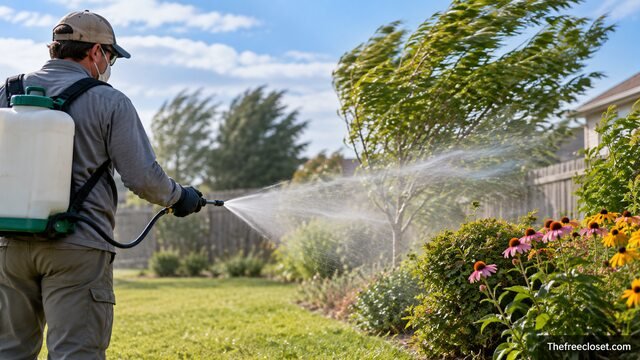
Wind can carry droplets away from the target and onto flowers, vegetables, shrubs, trees, neighboring property, or other sensitive vegetation.
There is no single wind-speed rule appropriate for every herbicide. Product labels may specify application restrictions, and some herbicides require particularly careful drift management.
Direction matters as much as speed. Even relatively light wind can be problematic if it is carrying spray directly toward sensitive plants. University of California guidance recommends considering both wind speed and direction and avoiding applications when conditions could move herbicide toward sensitive areas.
Very still conditions are not automatically safe either. Temperature inversions can allow fine droplets to remain suspended and move away from the application site.
Follow the label’s wind restrictions and postpone treatment when you cannot keep the spray on its intended target.
Should You Mow Before or After Spraying Weed Killer?
For foliar lawn herbicides, mowing immediately before treatment can remove much of the leaf surface that the spray needs to contact. Mowing too soon afterward may remove treated foliage before a systemic product has had sufficient opportunity to move through the plant.
Colorado State University Extension recommends avoiding mowing for two days before and after certain broadleaf lawn herbicide applications.
That does not make 48 hours a universal requirement. Your product label may specify another interval.
A practical approach is to leave enough healthy leaf area for good spray coverage, apply the herbicide according to the label, and delay mowing for the specified post-application period.
Common Timing Mistakes That Reduce Weed Killer Effectiveness
Many weed-control failures are caused by application conditions rather than the product itself.
Spraying immediately before rain is one example. The herbicide may not have enough time to enter the leaves. Spraying drought-stressed weeds is another because stressed plants may absorb and move systemic herbicides less effectively.
Other common mistakes include treating mature weeds when they could have been controlled earlier, spraying wet foliage with a product intended for dry leaves, mowing too close to application, treating during extreme heat, and ignoring wind direction.
Another mistake is assuming that more spray means better control. For spot treatment, Colorado State University recommends applying enough product to wet the leaf rather than soaking it until liquid drips off. Excess application can increase waste and the risk of damage without improving results.
A Quick Checklist Before You Spray
Before applying weed killer, check the following:
- Product: Is the herbicide labeled for the target weed and the area being treated?
- Weed stage: Are the weeds young and actively growing?
- Leaves: Are they in the moisture condition specified on the label?
- Temperature: Is it within the product’s permitted application range?
- Wind: Can you keep the spray away from desirable plants and other sensitive areas?
- Rain: Will the product receive its full required rainfast period?
- Irrigation: Can watering remain off for the required period?
- Mowing: Have you followed any pre- and post-treatment mowing restrictions?
- Equipment: Can you apply the labeled amount evenly without excessive runoff?
- Safety: Are you following all protective-equipment, mixing, application, re-entry, storage, and disposal instructions on the label?
If one of the critical conditions is wrong, postponing the application can produce better results than spraying simply because you have time available.
Conclusion
The best time to spray weed killer is not determined by the clock alone. Look for a weather window when the target weeds are young and actively growing, foliage meets the product’s moisture requirements, temperatures are moderate, wind conditions minimize drift, and rain will stay away for the herbicide’s required rainfast period.
For many liquid post-emergent lawn treatments, a calm period after morning dew has dried can be convenient. Spring and fall also frequently provide favorable growing conditions. However, different active ingredients behave differently, so the herbicide label should always override general timing recommendations.
Choosing the right weed, growth stage, weather conditions, and product usually matters more than choosing a specific hour of the day.
FAQ’s
Yes, evening can sometimes provide suitable temperatures and wind conditions. However, make sure the leaves and weather meet the product requirements, sufficient rain-free time remains, and atmospheric conditions do not indicate a temperature inversion.
For many liquid foliar herbicides, heavy dew is undesirable because it can dilute the spray or cause runoff. Wait for the foliage to dry unless the label says otherwise. Some granular broadleaf products are different and may benefit from moist foliage.
It depends on the product’s rainfast period. Some herbicides need only a relatively short dry interval, while others need several hours. Poor growing conditions can also slow absorption. Check the label rather than assuming one rain-free interval applies to every weed killer.
For many foliar lawn weed killers, avoid mowing immediately before spraying because you want sufficient leaf area to intercept the treatment. You may also need to delay mowing afterward. Some extension guidance suggests two days on either side for broadleaf lawn applications, but the product label should determine your exact timing.
Sometimes, but extreme heat can reduce application quality and increase the risk of volatility or injury with certain herbicides. Many post-emergence treatments work best under moderate temperatures while weeds are actively growing. Follow the maximum temperature and other weather restrictions stated on your product label.
Both can be effective because many broadleaf weeds are actively growing during these periods. The best season depends on the weed species and herbicide. Fall can be particularly useful for some perennial broadleaf weeds, while spring provides an opportunity to treat young weeds before they become larger.