Laundry Room Organization: Practical Ideas for a Cleaner, More Efficient Space
Laundry room organization is about creating a practical system that makes washing, drying, folding, and storing clothes easier. Keep frequently used supplies near where they are needed, use available storage efficiently, and remove unnecessary clutter.
Start by Removing What Does Not Belong
Before buying baskets, shelves, or storage containers, empty the obvious clutter from the laundry area. Organization products cannot compensate for storing too many things in too little space.
Sort what you find into four groups: laundry essentials, household supplies that genuinely need to stay in the room, items that belong somewhere else, and items to discard or responsibly dispose of.
Pay particular attention to duplicate or forgotten products. Three partially used stain removers, empty detergent containers, unmatched hangers, worn cleaning cloths, and products you no longer use can consume surprisingly valuable storage space.
Do not combine household chemicals simply to save space. Keep products in appropriate containers and follow the storage and safety directions on their labels.
Once unnecessary items are gone, organize what remains according to frequency of use. Everyday supplies deserve the easiest-to-reach locations. Backup products and occasional-use items can go higher or farther away.
Organize the Room Around the Laundry Workflow
A functional laundry room should support the order in which laundry actually happens:
Collect and sort → treat stains → wash → dry → fold or hang → return clothes
This sequence provides a better basis for organization than arranging products solely according to appearance.
Place hampers or sorting baskets near the point where dirty clothes enter the room. Keep detergent and frequently used washing products near the washer. Position dryer-related supplies close to the dryer. Create a clear surface for folding, and keep hangers near a rod or hanging area.
This approach reduces unnecessary movement. You should not have to cross the room repeatedly to complete a single load.
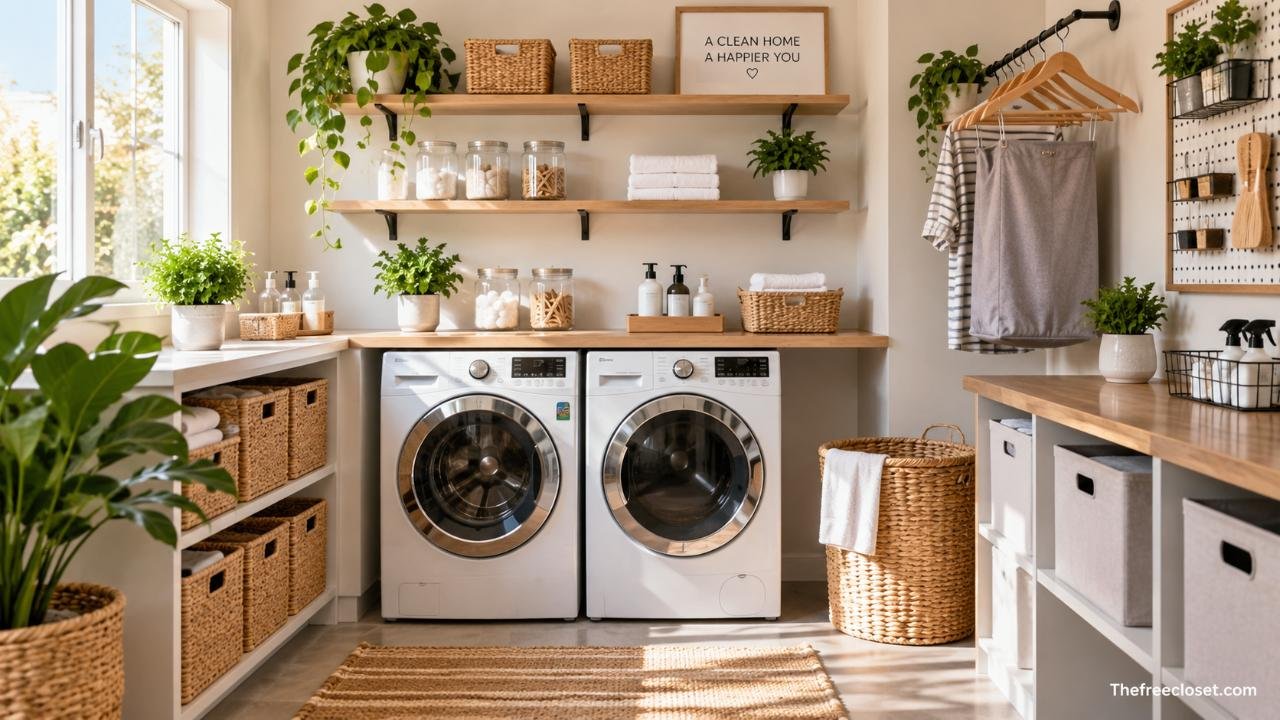
For example, imagine a narrow laundry room with the washer and dryer side by side. A practical setup might use three sorting hampers opposite the machines, detergent on a shelf directly above the washer, a hanging rod above the dryer, and a countertop spanning the appliances for folding. Each storage decision supports the next step in the process.
Create Storage Zones Instead of One General Supply Area
Dividing storage into zones prevents unrelated products from accumulating together.
| Zone | Good Items to Store There | Best Location |
| Sorting | Hampers, laundry bags, pocket-item container | Near the entrance or washer |
| Washing | Detergent and frequently used laundry products | Beside or above washer |
| Stain treatment | Stain-removal products and treatment tools | Near washer or utility sink |
| Drying | Dryer-related supplies and reusable drying accessories | Near dryer |
| Folding | Folding basket, garment-care tools | Counter or nearby cabinet |
| Hanging | Hangers and garment bags | Beside hanging rod |
| Backstock | Unopened replacement products | Upper shelf or cabinet |
| Cleaning | Approved household cleaning supplies | Separate designated storage |
The distinction between active supplies and backstock is particularly useful. If you have one detergent container in use and two replacements, all three do not necessarily need prime shelf space.
Keep the active product within easy reach and move unopened replacements to secondary storage. This simple rule can dramatically reduce visual clutter.
Use Vertical Space Before Sacrificing Floor Space
Laundry rooms frequently have unused wall space above washers, dryers, utility sinks, and hampers. Using this vertical area can add storage without narrowing the walkway.
Depending on the room, useful options include:
- Wall-mounted shelves
- Cabinets
- Pegboards
- Hooks
- Hanging rails
- Over-door organizers
- Wall-mounted drying racks
- Baskets or bins on upper shelves
Open shelves provide quick access and work well for frequently used supplies. Cabinets hide visual clutter and may be preferable when the laundry area is visible from another room.
Higher shelves are better suited to lightweight, infrequently used items than everyday supplies. Avoid creating a system that requires a step stool every time you wash clothes.
Also account for the appliances themselves. Do not block ventilation, connections, controls, access panels, or clearance required by the appliance manufacturer.
Make a Small Laundry Room Work Harder
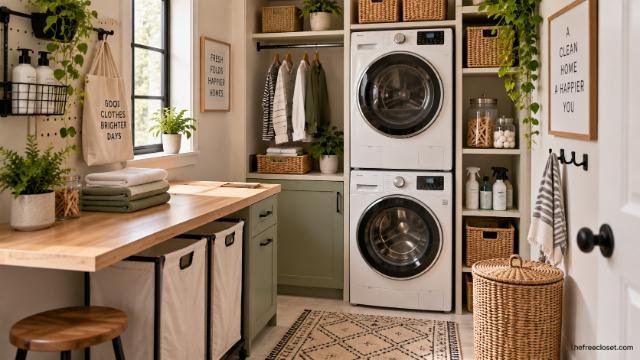
Small laundry rooms need selective storage rather than more storage everywhere. Every basket, cart, shelf, and container takes up physical space, so each addition should solve a specific problem.
Begin with overlooked areas. A narrow gap may accommodate a slim storage solution if it does not interfere with appliance clearance or connections. The back of a suitable door may hold lightweight accessories. Wall space can accommodate shelves or hooks. A compatible countertop above side-by-side front-loading machines may create a folding surface, provided the installation and appliance requirements allow it.
For a laundry closet, compactness matters even more. Instead of keeping large collections of supplies beside the machines, maintain only the products you regularly use.
Stackable or matching containers can make shelves easier to manage, but measure first. Storage products that are only slightly too deep can prevent doors from closing or make a narrow room uncomfortable to use.
Measure Before Buying Organizers
Record the width, depth, and usable height of cabinets, shelves, gaps, and walls. Also measure door swings and the space needed to access the washer and dryer.
Then compare those dimensions with the organizer’s external measurements, not merely its advertised capacity.
Leave enough clearance to remove a basket or bin without taking down everything around it. A container that technically fits a shelf but cannot be pulled out comfortably is not particularly useful.
Give Detergent and Laundry Supplies a Defined Home
Laundry products are among the biggest sources of countertop clutter because they are used frequently and tend to remain where someone last placed them.
Choose one accessible location for the supplies used during most loads. The exact products will depend on your household and washing routine, so avoid filling the space with products simply because they belong to the laundry category.
A tray or shallow bin can help contain frequently used bottles and makes the shelf easier to clean if a product drips.
Original packaging also provides instructions and safety information. If you transfer a product to another container, make sure doing so is appropriate for that product and does not create confusion about its contents or safe use. Household products should always be stored according to their labels and kept appropriately secured around children and pets.
Build a Better System for Sorting Dirty Laundry

Sorting clothes before laundry day can eliminate one of the most frustrating parts of the process.
A multi-compartment hamper can separate loads according to the categories your household actually washes. There is no universal sorting system that works for everyone. Your categories might be based on color, fabric, washing temperature, household member, or another routine that fits your clothing and machine instructions.
The important part is consistency.
In a household where laundry accumulates quickly, separate hampers can also act as visual indicators. When one section becomes full enough for an appropriate load, laundry can be started without emptying a single large hamper onto the floor to sort everything.
If floor space is limited, consider vertical or hanging sorting options rather than multiple freestanding baskets.
Create a Place for Clothes That Cannot Go Straight Into the Dryer
A laundry system often breaks down between washing and drying. Delicate garments, clothes that need to air-dry, and items that should be hung immediately can end up draped over doors, furniture, or appliances.
A dedicated drying and hanging area solves this problem.
Depending on available space, that might be a wall-mounted drying rack, retractable clothesline, ceiling-mounted rack, tension-style solution where appropriate, or a fixed hanging rod.
Keep empty hangers near this area instead of storing them in an unrelated closet. The easier it is to hang clothes immediately, the less likely clean laundry is to form another pile.
Check garment-care labels before deciding whether an item should be machine dried, air-dried, or handled another way.
Add a Folding Surface Without Making It a Clutter Magnet
A folding counter is useful only when it remains available for folding.
If you have side-by-side front-loading appliances and the manufacturer’s requirements permit it, a properly designed surface above them can turn otherwise unused space into a practical work area. A separate counter, utility table, or nearby surface can serve the same purpose.
Avoid covering the entire folding area with decorative containers. Leave most of it empty.
A useful rule is simple: storage belongs above, below, or beside the work surface, not permanently across it.
You can also assign a basket to each household member. Fold clean clothes, place them into the appropriate baskets, and move those baskets out of the laundry room instead of allowing finished loads to accumulate.
Control the Small Items That Create Big Clutter
Some of the most persistent laundry-room clutter comes from objects that do not have an obvious destination: coins, receipts, buttons, single socks, garment bags, clothespins, lint-removal tools, and miscellaneous pocket contents.
Give these recurring items small, specific homes.
A container near the washer can collect objects removed from pockets. A small basket can temporarily hold unmatched socks. Hooks can hold reusable laundry bags. A drawer divider can organize small garment-care tools.
The key word is temporarily. A lost-sock basket should not become permanent storage for socks that have been unmatched for two years.
Set a limit for these holding areas. When the container becomes full, review it instead of adding a larger container.
Hide Visual Clutter Without Hiding Everything
An organized laundry room does not require transferring every product into matching containers.
Closed cabinets are useful for visually busy packaging and less frequently used products. Open shelves are more convenient for things you reach for constantly. Combining the two usually produces a more functional result than using only one storage style.
Baskets can also group related items without requiring you to repackage their contents. A labeled basket for garment-care supplies, for example, can be removed from a shelf when needed and returned afterward.
Labels are most useful when multiple people use the laundry room. They establish where things should be returned, which helps the organization system survive beyond the initial cleanup.
Avoid over-labeling obvious items. A clearly visible hamper does not necessarily need a label saying “hamper.”
Make Awkward Spaces Useful
Laundry rooms often contain strange gaps caused by plumbing, appliance dimensions, doors, utility sinks, or cabinetry.
Instead of automatically filling every gap, first determine whether it needs to remain accessible for maintenance or appliance operation. If the space can safely be used, choose storage specifically suited to its dimensions.
A shallow wall may accommodate hooks rather than a deep shelf. A narrow area might hold a slim organizer. Space beneath a utility sink may provide storage if products can be stored there safely and plumbing remains accessible.
Corners are another common problem. Rather than filling a difficult corner with items you will forget about, reserve it for something intentionally occasional, such as an empty laundry basket.
The objective is usable capacity, not maximum capacity.
Keep Frequently Used Items Between Comfortable Reach Heights
Storage location should reflect how often an item is used.
Think of the room in three broad levels:
Easy reach: Everyday products, sorting supplies, and frequently used tools.
Secondary reach: Refills, occasional-use garment-care items, and extra baskets.
High or awkward storage: Lightweight items that are rarely needed.
This arrangement is more practical than distributing products according to container size alone.
Heavy containers should generally not be placed where retrieving them is awkward or unsafe. Similarly, frequently used items should not require repeated bending, stretching, or climbing when a more accessible location is available.
Households with children or pets also need to prioritize safe product storage over convenience.
Prevent the Laundry Room From Becoming Household Overflow Storage
Because laundry rooms often contain shelves and cabinets, they can gradually become storage areas for unrelated household items.
That usually begins innocently: a roll of paper towels goes on an empty shelf, followed by spare light bulbs, tools, shopping bags, seasonal decorations, and bulk purchases. Eventually, laundry supplies compete with everything else.
Set a boundary for what belongs in the room.
Items directly connected to laundry, garment care, and any intentional secondary function of the room can stay. Everything else should have a defined reason for being there.
If the laundry room also serves as a mudroom, pantry, cleaning closet, or utility room, establish separate zones for each function rather than mixing everything together.
Choose Organizers Based on the Problem, Not the Trend
Matching baskets and glass containers can look attractive, but appearance should come after function.
Use the problem-to-solution approach:
| Organization Problem | Practical Solution |
| Products cover the counter | Shelf, cabinet, or supply tray |
| Dirty clothes pile on floor | Hamper or sorting station |
| No room for air-drying | Wall-mounted or retractable drying solution |
| Supplies get lost on deep shelves | Pull-out bins or baskets |
| Small accessories disappear | Divided drawer or small container |
| Upper shelves become messy | Labeled bins for infrequent items |
| Clean clothes accumulate | Household-member baskets |
| No folding area | Compatible appliance-top counter or separate work surface |
| Unused wall area | Shelves, hooks, rail, or pegboard |
| Too many backup products | Dedicated backstock zone |
This prevents a common organizing mistake: buying containers first and deciding what to put in them later.
Before purchasing anything, identify the exact frustration you are trying to eliminate.
Create a Laundry Routine That Maintains the Organization
Even a carefully organized room will become cluttered if the routine does not support the storage system.
A sustainable reset can be extremely short. After finishing laundry, return supplies to their designated places, remove empty packaging, wipe obvious spills, clear the folding surface, and take finished clothes out of the room.
Periodically check backstock before buying more detergent or other supplies. This reduces accidental duplicates and prevents cabinets from filling with products you already have.
It can also help to keep one intentional empty area. An empty shelf section or part of the countertop gives the room flexibility when you need to sort a load, set down a basket, or temporarily handle an unusual item.
An organized space does not need every inch filled.
Common Laundry Room Organization Mistakes
One mistake is buying storage before decluttering. This often produces neatly contained clutter rather than a genuinely functional room.
Another is organizing for appearance instead of workflow. If detergent looks attractive on the opposite side of the room but you use it at the washer, the system adds work.
A third mistake is using oversized containers. Large bins can waste shelf capacity when their contents occupy only half the space.
Also avoid making every supply equally accessible. Products used once every few months should not occupy the same prime storage area as everyday detergent.
Finally, do not ignore appliance access and safety requirements for the sake of storage. Shelving, countertops, carts, and other additions should not interfere with connections, ventilation, operation, required clearances, or maintenance access.
A Simple Laundry Room Organization Plan
If the room currently feels overwhelming, organize it in this order:
- Remove everything that does not need to stay.
- Group the remaining items by function.
- Identify your normal laundry workflow.
- Measure available shelves, walls, cabinets, and gaps.
- Assign accessible storage to frequently used supplies.
- Move backup products into secondary storage.
- Establish a dirty-laundry sorting system.
- Create places for drying, hanging, and folding.
- Contain small miscellaneous items.
- Add organizers only where a specific storage problem remains.
- Label shared storage where labels will improve consistency.
- Keep at least part of the main work surface clear.
This sequence matters. If you buy organizers at step one instead of step ten, you may spend money storing items that should have been removed in the first place.
Conclusion
Effective laundry room organization is less about buying attractive storage and more about designing the space around the work that happens there. Remove unnecessary items first, arrange supplies according to the wash-and-dry workflow, use vertical space thoughtfully, separate everyday products from backstock, and protect your folding and hanging areas from clutter.
For a small laundry room, be even more selective. Measure before buying organizers and give valuable space only to items you genuinely use. When every storage decision makes a laundry task easier, the room becomes simpler to maintain instead of requiring another major reorganization a few months later.
Discover the latest fashion trends, home ideas, travel tips, and lifestyle inspiration at thefreecloset.com.
FAQ’s
Use wall-mounted shelves, hooks, baskets, a pegboard, an appropriate over-door organizer, or a freestanding shelving unit where space allows. Group visually cluttered supplies inside baskets while keeping frequently used products easy to access. Make sure additions do not interfere with appliances, doors, ventilation, or utility connections.
Prioritize vertical storage and reduce the number of products kept beside the machines. Use wall space before adding floor storage, choose organizers based on exact measurements, and keep only frequently used supplies within immediate reach. Avoid filling every available gap simply because storage will fit there.
Keep products and tools that support the room’s actual functions. Frequently used laundry supplies should occupy accessible shelves, while unopened replacements and occasional-use items can go higher. If the room serves another purpose, such as household cleaning storage, give that category its own clearly defined area.
Make storage locations easy enough that returning an item takes little effort. Clear the folding area after each laundry session, remove empty containers promptly, and check existing supplies before buying replacements. Small holding containers for miscellaneous objects should also have limits so they do not become permanent clutter.
Original packaging provides the product identity, instructions, warnings, and other information supplied by the manufacturer. If you are considering transferring a laundry product into another container, first check the product’s storage guidance and make sure the alternative does not create confusion or a safety risk. Appearance should not take priority over safe storage.
Create a system that reduces sorting and makes ownership clear. Depending on the household, that could mean divided dirty-laundry hampers plus separate baskets for each person’s clean clothes. The best categories are the ones that match how your household actually washes, dries, folds, and puts away clothing.