


Introduction
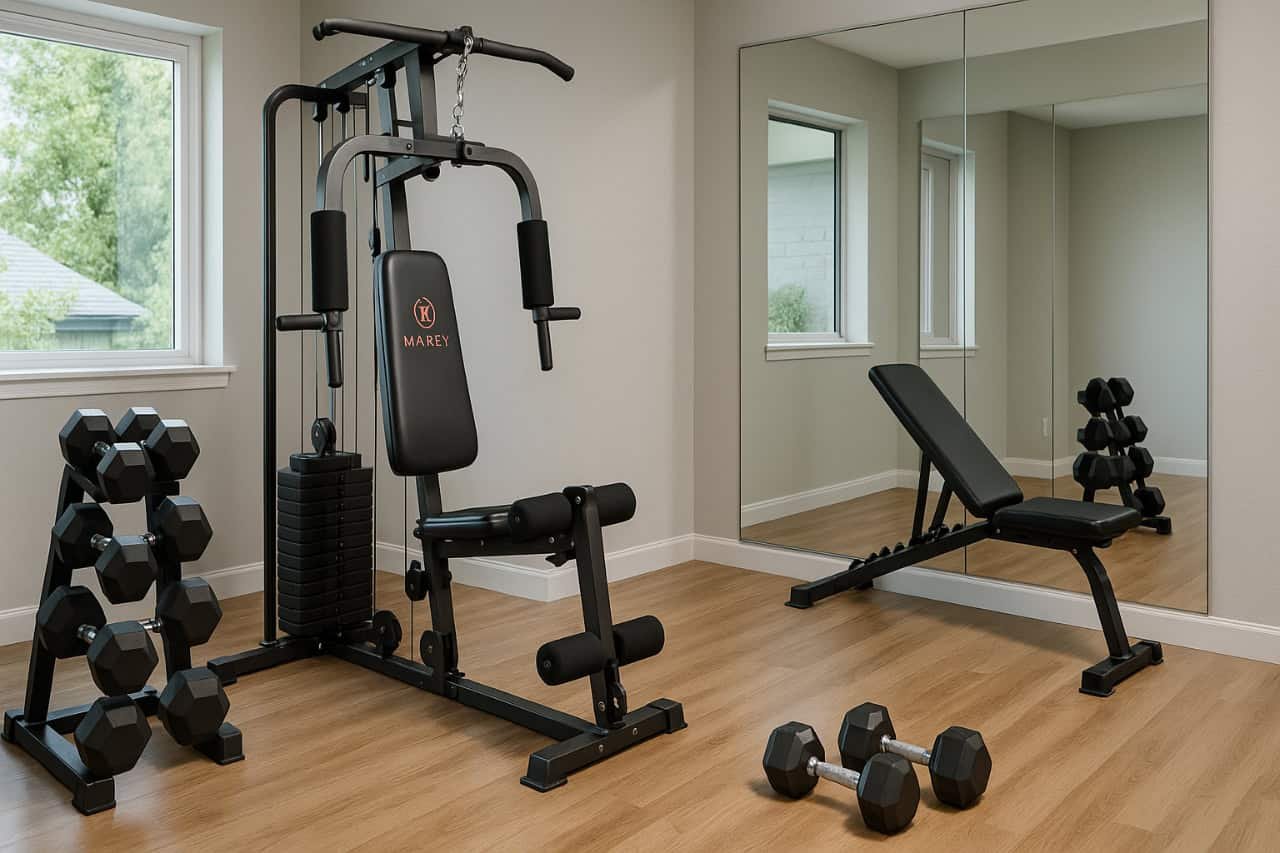
The Marcy Home Gym line has redefined how fitness enthusiasts approach strength training at home. Built for users who value efficiency, these systems integrate multiple exercise stations into one compact frame offering resistance-based workouts for every major muscle group. As home fitness adoption accelerates worldwide, Marcy’s multi-station gyms (especially models like the MWM-990, MWM-988, and MD-9010G) have become key players in the home workout market.
This guide explores how these machines work, breaks down their components, reviews top models, explains their pros and cons, and helps you choose the best setup for your space, goals, and budget. You’ll also find detailed maintenance steps, buying advice, and comparisons against other leading brands like Bowflex and Total Gym.
What Is a Marcy Home Gym and How Does It Work?
A Marcy Home Gym is an integrated strength-training system that enables users to perform dozens of resistance-based exercises from one centralized unit. The equipment typically includes a selectorized weight stack, cable pulley system, and press or leg attachments that simulate the functionality of several machines found in commercial gyms.
Unlike free weights, which rely on gravity and balance, Marcy’s cable-driven resistance system keeps tension constant throughout each movement. This provides a safer environment for solo training ideal for users without a spotter. By pulling or pressing against handles attached to cables, users engage specific muscle groups depending on pulley direction and attachment point.
The Marcy home gym concept centers on mechanical efficiency combining the principles of leverage, cable resistance, and ergonomics to create a complete training station suitable for compact home spaces.
What Components and Mechanisms Are Inside a Marcy Home Gym?
Each Marcy gym integrates several mechanical elements designed to distribute resistance evenly and maximize motion efficiency:
| Component | Function and Description |
| Main Frame | Constructed from 14-gauge or 12-gauge steel tubing, providing structural integrity and vibration resistance. |
| Selectorized Weight Stack | A vertical stack of weight plates linked to the pulley system through a selector pin; typically ranges from 100–200 lbs. |
| Pulley and Cable Network | Transfers motion and resistance; high-quality nylon or steel-reinforced cables run over smooth pulleys for minimal friction. |
| Press Arms and Levers | Adjustable arms simulate bench press, shoulder press, and row movements. |
| Leg Developer Attachment | Enables leg extensions and curls for quadriceps and hamstrings. |
| Preacher Curl Pad and Lat Bar | Designed for isolated biceps and latissimus dorsi training. |
Preacher Curl Pad and Lat Bar Designed for isolated biceps and latissimus dorsi training.
These elements combine to form a closed kinetic chain system where each movement follows a controlled path. The result is reduced risk of injury, improved isolation, and a consistent resistance curve.
How Does the Weight Stack and Pulley Ratio System Function?
One of the defining engineering aspects of Marcy gyms is their pulley ratio system. This ratio determines how the load from the weight stack translates to actual resistance felt at the handle.
For example, in a 2:1 ratio, pulling 100 lbs from the stack generates 50 lbs of effective resistance. Marcy often uses this design to create a smoother, more manageable resistance for beginner-friendly models like the MWM-990. Higher-end Smith or cable cross models may use 1:1 or variable ratios, giving advanced lifters direct load translation.
| Model | Weight Stack | Pulley Ratio | Effective Resistance Output |
| MWM-990 | 150 lbs | 2:1 | 75 lbs |
| MWM-988 | 150 lbs | 1:1 | 150 lbs |
| SM-4033 (Plate-Loaded) | N/A | Variable | User-Defined |
Understanding this ratio helps users plan progression. For instance, a beginner may thrive with a 2:1 ratio that prioritizes smooth movement, while an intermediate athlete might choose a 1:1 system for heavier load potential.
Which Marcy Home Gym Models Are Available and How Do They Differ?
Marcy offers a range of home gym models designed for different fitness levels, space requirements, and training styles. The most popular selectorized stack models like the Marcy MWM-990, MWM-988, and MWM-1005 use a built-in weight stack system that provides smooth, controlled resistance for up to 30+ exercises. These are ideal for beginners and intermediate users who want a compact, all-in-one strength machine.
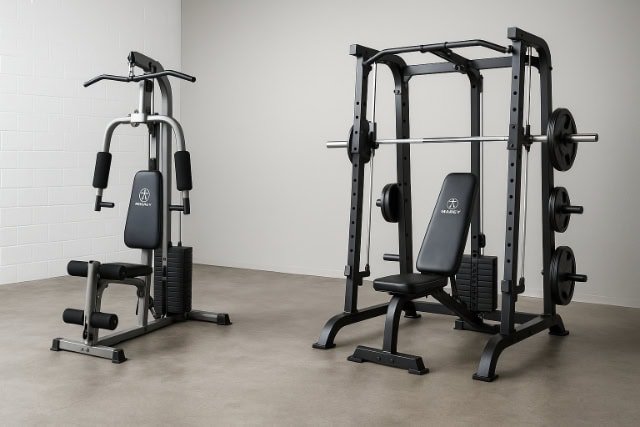
For users seeking heavier lifting capacity and more versatility, plate-loaded and Smith machine combos such as the Marcy MD-9010G and SM-4033 combine cable crossovers, Smith bars, and racks for advanced strength training. They allow for compound lifts like squats, bench presses, and deadlifts, while still supporting cable isolation exercises.
Smaller or space-saving options, like the Marcy SM-1050, offer hybrid cable systems with pull-up stations and adjustable pulleys, making them perfect for apartments or garage gyms. Overall, the main differences among Marcy models come down to resistance type (stack vs. plate-loaded), exercise variety, and footprint size allowing you to choose based on your fitness goals and available space.
What Are the Specs and Features of Marcy MWM-990?
The Marcy MWM-990 is Marcy’s flagship all-in-one home gym, designed around a 150-lb selectorized stack. It provides a balanced mix of upper and lower body stations, compact enough for apartment or garage setups.
Key Features:
- Dual-function press arms for chest and shoulder movements
- High and low pulleys for rows, curls, and pulldowns
- Leg developer with foam rollers
- Removable preacher curl pad
- Ergonomic adjustable seat and back pad
Dimensions: 68” L × 42” W × 78” H
Exercise Variety: 30+ unique exercises
The MWM-990 is ideal for general fitness, toning, and muscle endurance. The smooth pulley travel and consistent tension make it perfect for controlled reps, while the padded seat ensures comfort during long sessions. Maintenance is minimal usually just periodic lubrication of pulleys and tightening of bolts.
What Are Smith Machine and Cable Combo Models from Marcy?
For lifters seeking more flexibility and heavier resistance, Marcy’s Smith machine hybrids like the MD-9010G and SM-4033 combine guided barbell systems with dual adjustable pulleys and bench attachments.
These machines allow users to perform traditional barbell movements safely, with integrated safety catches and linear bearings. The dual pulley systems on either side provide functional cable motion for crossover, triceps, and core exercises.
| Model | Resistance Type | Key Features | Target User |
| MD-9010G | Plate-loaded + Cables | Smith bar, cross pulleys, bench | Advanced |
| SM-4033 | Plate-loaded | Rack, adjustable pulleys, pull-up bar | Intermediate-Advanced |
| SM-1050 | Compact Smith + Cable | Space-saving, pull-up handles | Home users with limited space |
These models blend free-weight dynamics with machine stability, appealing to serious lifters who still value compact design. The result is a hybrid gym capable of both isolation and compound movement patterns.
What Are the Advantages and Disadvantages of Using a Marcy Home Gym?
A Marcy Home Gym offers excellent versatility for full-body workouts in a small space. With its multi-station design, users can train major muscle groups chest, back, legs, and arms all on one compact unit. It’s ideal for home users who want gym-level functionality without multiple machines.
The system’s safety and convenience are major benefits. Its guided motion and constant cable resistance make it safer for solo workouts compared to free weights. Assembly is straightforward, and maintenance needs are minimal.
Marcy’s machines are also known for affordability and durability. Built from heavy-duty steel and smooth pulley mechanisms, they provide years of reliable use at a fraction of the cost of commercial gym memberships.
What Exercises Can You Realistically Do with One Machine?
Depending on the model, users can perform 25 to 40 exercises, including:
Upper Body:
- Chest press and fly
- Lat pulldown
- Seated row
- Triceps pushdown
- Biceps curl
Lower Body:
- Leg extension
- Hamstring curl
- Glute kickback (via low pulley)
Core:
- Ab crunch (via high pulley)
- Cable rotations and twists
When paired with accessories such as ankle straps and triceps ropes, the exercise library expands further. This flexibility allows users to rotate routines weekly, promoting balanced muscular development.
What Limitations Do Users Report (Resistance, Durability, Range of Motion)?
While Marcy gyms excel in usability, there are minor limitations to note:
- Resistance Ceiling:
A 150-lb stack may not challenge advanced users performing compound lifts like chest presses or rows. Supplementing with free weights or resistance bands helps bridge that gap. - Cable Wear:
Over time, cables can stretch slightly, reducing effective resistance. Replacing them every few years ensures consistent performance. - Seat and Foam Durability:
Continuous heavy use can compress foam pads, especially on preacher curl stations. - Limited Customization:
Movement paths on some models are fixed, meaning exercises like incline presses or wide-grip rows aren’t as adjustable as in commercial machines.
Still, for 90% of home users, Marcy systems provide outstanding value for money and require minimal upkeep compared to free-weight setups.
How to Choose the Right Marcy Home Gym for Your Needs
Choosing the right Marcy Home Gym depends on your goals, available space, and experience level. If you’re new to resistance training, start with compact models like the Marcy MWM-990 or MWM-988. These machines provide a 150-lb weight stack, smooth cable motion, and enough exercise variety for total-body workouts without taking up much space.
If you’re an intermediate or advanced user seeking more resistance and versatility, consider plate-loaded or Smith machine combo models like the MD-9010G or SM-4033. They support heavier loads, include adjustable pulleys, and let you perform both machine and free-weight exercises safely.
Before purchasing, measure your workout area most setups need about 6×4 ft of floor space and 7–8 ft ceiling height. Also think about your long-term goals: if you plan to progress in strength, choose a model that allows stack or plate upgrades. For shared family use, a higher weight capacity ensures everyone can train effectively.
What Room Dimensions and Ceiling Height Do You Need?
Most Marcy home gyms fit within 6 ft × 4 ft floor space. However, you should allow at least 2 ft of clearance on all sides for safe movement and pulley travel.
Ceiling Height Recommendations:
- Standard stack systems (MWM-990): 7–7.5 ft
- Smith combos (MD-9010G): 8 ft or more
Before purchasing, measure your room height including any light fixtures or garage door rails. For flooring, use rubber mats or foam tiles to protect surfaces and absorb impact.
Also, consider ventilation and temperature control, as cable machines perform best in moderate environments without humidity exposure.
What Weight Stack Size Is Ideal for Your Goals?
Choosing stack weight influences long-term training adaptability.
| User Type | Weight Stack Range | Recommended Models | Training Focus |
| Beginner | 100–150 lbs | MWM-990, MWM-988 | General fitness |
| Intermediate | 150–200 lbs | MWM-1005, MWM-4943 | Muscle gain |
| Advanced | Plate-loaded | MD-9010G, SM-4033 | Strength & hypertrophy |
If you plan to progress beyond 150 lbs of resistance, consider hybrid systems that allow plate-loading or future stack upgrades. For couples or family use, higher stack capacity provides shared adaptability.
How to Set Up, Maintain, and Troubleshoot a Marcy Home Gym
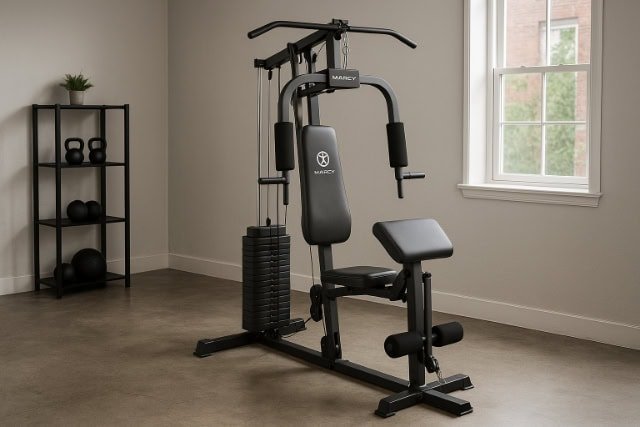
Setting up a Marcy Home Gym starts with preparing a clean, level space with enough room for movement. Unbox and organize all parts before beginning assembly. Build the base frame first, then attach the upright posts, pulleys, and cables exactly as shown in the manual. Once the structure is secure, install the weight stack, press arms, and seat pads. Two people can usually assemble the gym in 2–4 hours using standard tools.
After setup, regular maintenance keeps your machine smooth and safe. Wipe down metal parts after workouts to prevent rust. Lubricate pulleys and guide rods every few months with silicone spray for smoother motion. Check cables and bolts monthly tighten any loose parts and replace frayed cables immediately. Clean the vinyl seat pads with mild soap to prevent cracking.
If you notice uneven resistance or jerky motion, the issue is usually cable misalignment or a twisted pulley. Recheck the routing diagram to ensure cables are properly threaded. Noisy operation often indicates dry bearings apply light lubricant. For a wobbly press arm or bench, tighten pivot bolts and realign the pins.
What’s the Step-by-Step Assembly Process?
- Prepare the area: Choose a clean, level surface. Lay out all components.
- Build the base frame: Secure using bolts and washers before moving upward.
- Install vertical posts and support beams: Align carefully to ensure squareness.
- Mount pulleys and route cables: Follow the instruction diagram exactly to prevent misalignment.
- Add the weight stack: Slide plates over guide rods and attach the top plate to the cable chain.
- Attach moving arms, seat, and padding: Test mechanical range after tightening.
- Calibrate resistance: Pull cables under no load to verify even tension.
Two people can typically assemble the system in 2–4 hours. Marcy’s manuals are detailed with visual diagrams, making the process intuitive even for first-time builders.
Maintenance and Troubleshooting Tips
- Cable Inspection: Check for frays every six months; replace immediately if visible wear appears.
- Lubrication: Use silicone-based lubricant on pulleys and guide rods quarterly.
- Tighten Bolts: Prevent wobbling by retorquing fasteners periodically.
- Seat Care: Wipe vinyl surfaces after use to prevent cracking.
- Cable Drag Issues: If movement feels jerky, ensure pulleys spin freely and aren’t overtightened.
Common Troubleshooting Cases:
- Uneven Resistance: Cable misrouting or twisted pulleys re-thread as per manual.
- Noisy Operation: Dry bearings apply silicone spray.
- Loose Press Arm: Tighten pivot bolts and re-align lock pins.
Regular care not only extends longevity but ensures smooth biomechanics critical for joint safety.
How Does Marcy Home Gym Compare to Alternatives?
Marcy competes directly with Bowflex, Total Gym, and Life Fitness in the home gym category. Each system uses a different resistance technology, appealing to unique audiences.
| Brand | Resistance Type | Training Style | Maintenance | Typical Cost |
| Marcy | Weight stack / Plate-loaded | Traditional strength | Low | $500–$2,000 |
| Bowflex | Power Rod tension | Endurance & toning | Medium (rod replacement) | $800–$1,800 |
| Total Gym | Bodyweight incline | Functional mobility | Very low | $400–$1,200 |
| Life Fitness G4 | Commercial stack | Heavy strength | Low | $2,500+ |
Analysis:
Marcy offers the most balanced solution true resistance progression, compact design, and affordability. Bowflex excels in smoothness and low impact but lacks heavy overload potential. Total Gym prioritizes bodyweight versatility but not hypertrophy. Life Fitness delivers premium quality at a higher price point.
For most home users, Marcy’s mechanical simplicity, spare parts availability, and long-term reliability make it the best value per dollar option in the multi-gym segment.
Where Can You Buy a Marcy Home Gym, and How Much Does It Cost?
Marcy products are widely distributed both online and in stores, with consistent availability across North America and Europe.
| Retailer | Price Range (USD) | Purchase Benefits |
| MarcyPro.com | $500–$2,000 | Official warranty, parts support |
| Amazon | $450–$1,600 | Fast delivery, verified reviews |
| Walmart | $500–$1,200 | Budget-friendly bundles |
| Dick’s Sporting Goods | $700–$1,800 | In-store display, assembly service |
Prices vary by region and model configuration. Expect additional cost for benches, attachments, or mats. Always verify product dimensions and warranty terms before ordering.
Conclusion
The Marcy Home Gym remains one of the most trusted and affordable all-in-one strength solutions on the market. By integrating smart pulley systems, durable frames, and multi-function stations, it empowers users to train safely and effectively without leaving home.
Whether you opt for the MWM-990 for compact functionality or the MD-9010G for hybrid strength, each model carries Marcy’s hallmark of reliability and ergonomic design. With regular maintenance and thoughtful space planning, a Marcy gym can last over a decade making it a wise long-term investment in your health and fitness journey.
FAQ’s
Most models allow between 25 and 40 exercises, covering upper body, core, and lower body training.
Yes. For beginners and intermediates, 150 lbs (especially at 1:1 ratio) provides sufficient load. Advanced users may use free weights for supplementary training.
Around 6×4 ft of floor area and 7.5 ft ceiling height. Smith cages require closer to 8 ft.
Expect 2–4 hours with two people and basic tools.
Cables, pulleys, and seat padding are the most common replacements after long-term use.
Some models offer stack upgrade kits or plate-loading options; verify before purchase.
Marcy focuses on true resistance and stability, while Bowflex and Total Gym emphasize portability and low impact. Each suits a different user type.
With proper care, 8–12 years of consistent use is common before major part replacement.
Visit MarcyPro.com or authorized dealers for official cables, pulleys, and pads.
